
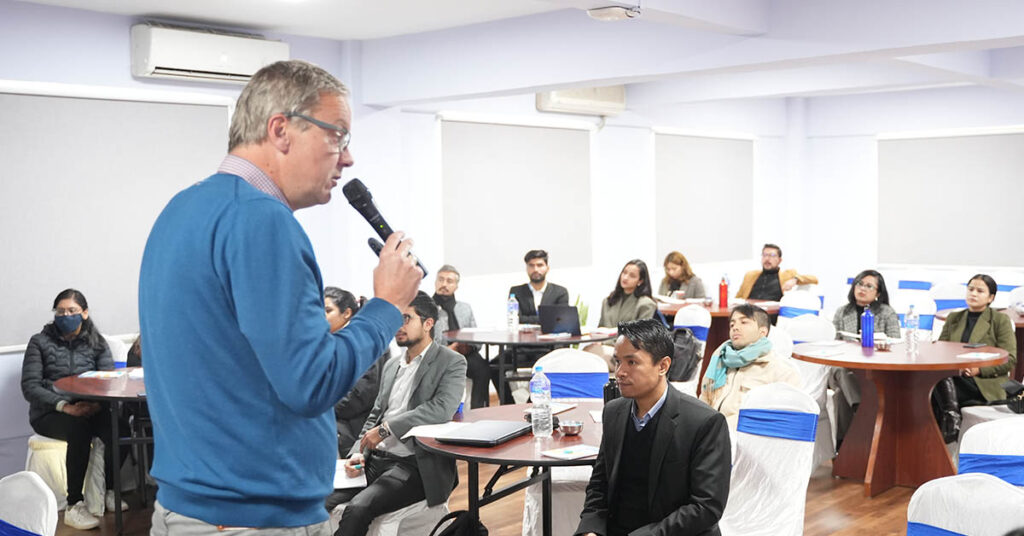
Center for Research and Development (CERAD) at King’s College, spoke to various
entrepreneurs / founders of startups in a bid to identify the most common issues and challenges that they
face in Nepal. The interview was conducted with individual founders from eight different startups
operating in various industries over a course of a week. Although there was a multitude of challenges
faced by each founder.
Below are the Most Common ones that we Identified, listed in Chronological Order
1. HUMAN RESOURCES
2. FINANCE
3. CONSUMER AND CUSTOMER ACCEPTANCE
4. SUPPLY CHAIN
5. POLICY
6. MENTORSHIP AND NETWORKING
7. COLLABORATION AND KNOWLEDGE SHARING
8. CULTURAL ASPECT
9. SUPPORTING BODIES AND ECOSYSTEM
10. PROPER DECISION-MAKING AND STRATEGIC THINKING
1. HUMAN RESOURCES
One of the prominent issues faced by founders and their startups in Nepal is the lack of adequate, loyal,
and competent employees. In the research conducted by (Rijal et. al., 2021), “one of the main challenges
faced by the startup was that people who were skilled to join the business preferred applying to
established companies. Due to this the employee attrition rate in the startups was very high as startups
are often associated with risk and instability. The research also pointed out that the employees in
startups often switched to well-paid jobs or chose to go abroad which led the startups to reinvest in new
resources, training, and orientation often.” Similarly, Punit Jajodia from Programiz who is involved in the
IT sector lamented that employee retention was one of the challenges he faced in the startup. He shared
that previously he recruited young people and trained them for the job but they only lasted for a short
term. Thus, tackling the challenges of employee retention he stated that he had now started recruiting a
senior pool of job applicants concerning the stability that they can bring to the company. Rajan
Chakradhar, the co-founder of ‘Upcycle Nepal-Revive’, a company that upcycles unused fabrics into utility
products, stated that it is a challenge to find the right type of workers required for the production process
and to make them stay with the company for a longer duration. Similarly, Sandip Subedi of Upaya City
Cargo, an online logistics company, posited that due to the unavailability of adequate partner riders, the
delivery of orders was delayed in their initial phase of business, adversely impacting their normal
operations.
2. FINANCE
Finance is one of the important aspects of any startup for maintaining its sustainability. Through the
interview, it was found that many of the startups started with bootstrapping so the initial funding wasn’t a
major challenge but became one in the latter part when it came to scaling up the business. They shared
that scaling up the business was a big challenge as it requires a larger source of capital. For scaling up the
business, access to finance such as venture capitalist and bank loans were also seen to be difficult to
access for the entrepreneurs. “Nepal’s ecosystem lacks the real venture capitalists who could provide the
risk capital and bear the risk of the companies for a small amount” (Rijal et. al., 2021). When CERAD
spoke to Manish Jung Thapa of ‘Antidote’, a clothing rental service provider in Lalitpur, it was found that
there was a severe constraint on financial sustainability due to an inadequate supply of sources of
finance. There seems to be a lack of alternative sources of raising investments for startups, especially in
cases where banks do not easily provide financial support. This acts as a barrier to sustaining the
business. There is also limited financial planning and cash flow management practice in many startups
and enterprises. This gap in financial planning can act as a challenge for startups in the long run.
Another important financial aspect of any startup is cash flow management as it helps to ensure the
financial health and sustainability of the organization. The startup needs to look into the cash coming in
and the cash flowing out. Based on the insights from Narottam Aryal, President of King’s College, “many
startups tend to have limited financial literacy which leads to poor cash flow management which can
then lead to the shutdown of startups. Poor cash flow management in times of crisis such as pandemic
can put startups in various challenges in terms of the company’s sustainability.”
3. CONSUMER AND CUSTOMER ACCEPTANCE
The challenges of scaling up the product or service is often heightened when the startup is unable to get
into the market and is accepted by its targeted consumers in the market. Similarly, many interviewed
entrepreneurs highlighted the challenge of scaling their venture in the market. For instance, Prajwal
Khadka, the co-founder of ‘Coffee of Promise’, a Nepali wholesale organic specialty coffee roasting
company stated that they face struggles in fixing appropriate pricing for their product due to the coffee
industry being a homogenous market with many competitors selling at cheaper prices. This makes coffee
consumers extremely cost-sensitive and thus makes it difficult for firms like his to achieve economies of
scale. Additionally, creating awareness and getting the product accepted on a large scale among wide
groups of customers is also a major challenge. Rajan Chakradhar stated that customers are often hesitant
to spend too much money on upcycled utility products such as bags due to reasons such as consumers’
preconceived notion that recycled products made from old fabric are dirty, unhygienic, and unhealthy.
However, Rajan confirms that old collected fabrics are sanitized and washed thoroughly before being
passed on to the production process. As many customers consider upcycled products to be of inferior
quality, they mostly prefer to purchase conventional goods, which drives down the market potential and
size for companies such as one run by Rajan.
4. SUPPLY CHAIN
Startups also face logistical challenges when it comes to sourcing and storing inputs and final products.
Vedika Murarka, the co-founder of Educase, a startup that manufactures backpacks that fold into a desk,
stated that she had difficulty finding the appropriate supplier of materials required to produce the
backpacks. Furthermore, as the initial prototype was designed in London, she faced difficulty in
identifying a competent manufacturer in Nepal who would be able to produce the backpacks on a wider
scale without compromising the quality and durability. She lamented that as there is no proper
information/database on suppliers and manufacturers in Nepal, she had to spend ample time in search of
one and convince them to produce the backpacks. Similarly, Shreya Upadhyay of Sweet Fix, stated that
due to a lack of cold storage, her company has had to face restrictions in supplying popsicles to
consumers in locations further away from its physical stores. This has limited her goal of achieving a
wider consumer market and scalability. The interviewees mentioned that networking with the right
suppliers, investors, and key partners would make the scaling of a business easier.
5. POLICY
While interviewing the founders, many also highlighted the complex and ambiguous nature and policies
of registration of their startups. Additionally, the rules of taxation are also cumbersome and
time-consuming as the authorities to whom the startups like Educase have to pay taxes were rather
unclear. Also, the issue of intellectual property rights violations is omnipresent in Nepal as obtaining a
patent for an innovative product is rather a time-consuming process. For instance, Vedika from Educase
filed a patent application for her innovative product about 10 months ago, however, to date she has not
been able to acquire the patent. Due to this, Educase faces a serious threat of copyright violation and the
inability to launch her product in a foreign location due to lack of patent. Although Upaya City Cargo is a
logistics company, the regulatory authorities asked the company to register as a rental services provider,
causing the partner riders to pay more taxes on their earnings.
When a rule is made universal without the consideration of a variety of industry needs and
circumstances it creates restrictions for industries which can help boom the economy of the country as
well as help in the sustainability of the startups. One such issue of blanket rules was mentioned by the
co-founder of Programiz, Punit Jajodia. He shared that the transaction limit as per the dollar card is only
USD 500 annually which means that the user cannot store or use more than that amount. As the IT
industry as well as other industries are booming, the limit puts a restriction on the entrepreneurs to
access the amount of money they have earned to scale up their business. An extension process to access
the money would help a lot for entrepreneurs in this age of globalization to sustain their companies
financially.
Experts mentioned that all the policies are vague at their inception and that policies get defined and
broader as the number of businesses increases. On the other hand, entrepreneurs stated that clear
policies and guidelines would help them operate.
6. MENTORSHIP AND NETWORKING
Mentorship can help entrepreneurs and startups to navigate several challenges from the knowledgeable
lens of experts. A mentorship can only be effective for startups if they are industry based rather than
general. Kritika Lamsal and Shreya Upadhyay from SweetFix, a handcrafted popsicle company shared
that whenever there is a mentorship event or program they seek expertise from industry-based experts
who can help them navigate the specific problems related to food and manufacturing issues. It was found
that the mentorship mismatch was a challenge for them. The entrepreneurs require mentors but the
mismatch was often time-consuming and wasn’t beneficial at all as they didn’t find the advice helpful to
solve the real problem they were facing.
7. COLLABORATION AND KNOWLEDGE SHARING
One of the many issues shared by the entrepreneurs was the lack of knowledge sharing among one
another and the platforms to facilitate such dialogue. Manish Jung Thapa from Antidote shared that, ‘If
there would have been effective knowledge sharing among the Nepali startup community it would have
helped to tackle several common trials and errors. He also shared that access to a database of
industry-based key experts is lacking but essential.’ Similarly, other interviewed entrepreneurs also
shared that it is very important to understand the basic legal, financial, and operational aspects of
running a business, and a proper knowledge-sharing platform can help to fill this gap. Additionally,
Prajwal posits that there is a lot of competition in the market but barely any collaboration amongst the
entrepreneurs which can be an effective lead to information and knowledge sharing.
8. CULTURAL ASPECT
When asked to give advice to people who want to pursue entrepreneurship or build a startup, the most
common advice from the interviewed entrepreneurs was that starting a business is not easy and having
passion is not enough. Kritika Lamsal and Shreya Upadhyay from Sweet Fix shared that entrepreneurship
has been too glamorized which overshadows the hardships behind running a business. Many programs
conduct idea pitching and host glamorized entrepreneurship-based programs, albeit all of them are not
valuable when it comes to sustaining and supporting the business in the long run. Both Manish Jung
Thapa from Antidote and Prajwal Khadka from Coffee of Promise also shared that when one considers
running a business, patience, courage, perseverance, and the will to struggle should be there. Thus, the
current over-glamorization of entrepreneurship has trapped many entrepreneurs on the verge of failure
as the journey of entrepreneurship is not limited to portrayed glitz and glamor. This culture of
over-glamorization of entrepreneurship acts as a challenge for the startups as much of the resources is
invested in glamorizing the field with various programs which could have been instead used to invest in
scaling up the startups. Another major aspect of culture is the perception in Nepali families of startups
which is linked to failure and instability. Sandip from Upaya shared, “sometimes it is really difficult to
make the family understand why we are doing what we are doing.”
9. SUPPORTING BODIES AND ECOSYSTEM
Startups need a supportive ecosystem to bloom. When the established supporting bodies can help the
startups to accelerate focus on profit making rather than supportive value expansion it creates difficulties
for the startups. Prajwal Khadka from Coffee of Promise shared that it was difficult to find a partner who
genuinely wanted to support the startup. He shared that in exchange for the promotion of the product
and service, the big outlets who claim to support startups seek large percent profit in return. This is a
difficult position for startups to be in when it can be difficult for them to sustain themselves financially.
Even Vedika Murarka from Educase shared the difficulty of working with government bodies who
outrightly ask to over-invoice during the process of tender.
10. PROPER DECISION-MAKING AND STRATEGIC THINKING
When establishing a startup, the co-founders are the major pillar of the company. Prajwal Khadka from
the Coffee of Promise shared that he and his other two co-founders were the ones actively involved in all
of the major daily operations and work of the company. They are three people handling all the major
roles from management to the executive to operations to marketing. The same scenario was shared by
Punit Jajodia from Programiz. He shared that it was similar in his company as well. Punit shared that
because he was able to adopt all the required skills including the technical skills, it helped him to sustain
the company. As the founders have to lead as a jack of all trades, sometimes the process can bring
challenges in strategic decision-making, as the startups lack access to expertise. There are many rules,
regulations as well as policies surrounding the formation and operation of a startup. The companies
themselves have the liberty to set their own standard rules and regulations inside the company. As the
growth of the start-up can be a fluctuating journey, thus, it is important to strategize and standardize the
process with methods and approaches that work for the company. In context to this, Narottam Aryal
shared that in Nepal’s startup ecosystem, standardization is still an issue that can lead the startup towards
a lack of operational efficiency and consistency in the long run.
List of entrepreneurs interviewed:
1. Antidote – Manish Jung Thapa
2. SweetFix – Kritika Lamsal and Shreya Upadhyay
3. Upcycle Nepal – Revive Rajan Chakradhar
4. Upaya City Cargo – Sandip Subedi
5. Educase – Vedika Murarka
6. Programiz – Punit Jajodia
7. Coffee of Promise – Prajwal Khadka
By: Anant Tamang, Prakriti Joshi, Meghanath Dulal
