
Real Project: Green Tech, Agriculture and Nutrition is a 5-days International, Interdisciplinary & Entrepreneurial program desiged and lead by the Munich University of Applied Sciences (MUAS), Germany. The students from King’s College, Nepal, Durban University of Technology (DUT), South African and MUAS, Germany came together virtually to brainstorm, identify problems, and seek potential solutions around zero waste, healthy eating, and carbon footprint etc.
By Ashish Katwal
Student – BBA
As students, we rarely get an opportunity to think about real world challenges and find new ways to tackle those issues. Not everyone has the privilege to tackle the world’s problems or change the world, but everyone can play a part through their small efforts to instigate that change. I believe students like myself, given the right platform and opportunity, have the privilege to think about the world’s challenges and be prepared for the upcoming world.
I recently got an opportunity to join a week-long virtual program named Real Project: Green Tech, Agriculture and Nutrition. This program brought university students from three different countries: students from King’s College in Kathmandu, Nepal, Durban University of Technology in Durban, South Africa, and Munich University of Applied Sciences in Munich, Germany.
The objective of this program was to equip students with entrepreneurial thinking and action through the design thinking process* and interdisciplinary projects. By working on a real and relevant topic with an interdisciplinary team, we got to directly put our learnings into practice and build up our entrepreneurial skills and competencies.
The program was conducted using the design thinking process:

*Fig.1. Design thinking is an iterative process that has 5 major steps: Empathizing with users, Identifying the problem, Ideating a solution, Prototyping, and Testing to get feedback from the users.
A key principle of design thinking is to have a diverse team because innovation comes from diverse perspectives and interactions of different groups and communities. And the real power of design thinking lies in creating a space where the participants can work in an open, experimental, creative and trustful environment.
We had a total of six diverse and interdisciplinary teams consisting of participants from all three countries. Each team had to select a topic from the four umbrella themes:
- Zero waste(e.g. packaging)
- Diseases (e.g. obesity, diabetics, allergies)
- Carbon footprint (e.g. food production)
- Organic food consumption (e.g. price/availability)
The following are the different themes selected by each team:
Team 1 – Food and CO2 emissions
Team 2 – Organic farming, pollution, inequalities
Team 4 – Obesity among teenagers in germany due to behavioural change
Team 5 – Plastic reduction in University and Schools
Team 6 – Nutrition for professional athletes
Team 8 – Plastic Pollution in Ocean
After selecting our topic, we spent more than 8 hours everyday together, working from three different time zones. We were told that final solutions would be judged on the basis of Desirability, Viability, Feasibility, Degree of Innovation, Social Impact and Execution Quality.
Team 4 Obeutrition: “Your Health Is In Your Hand”
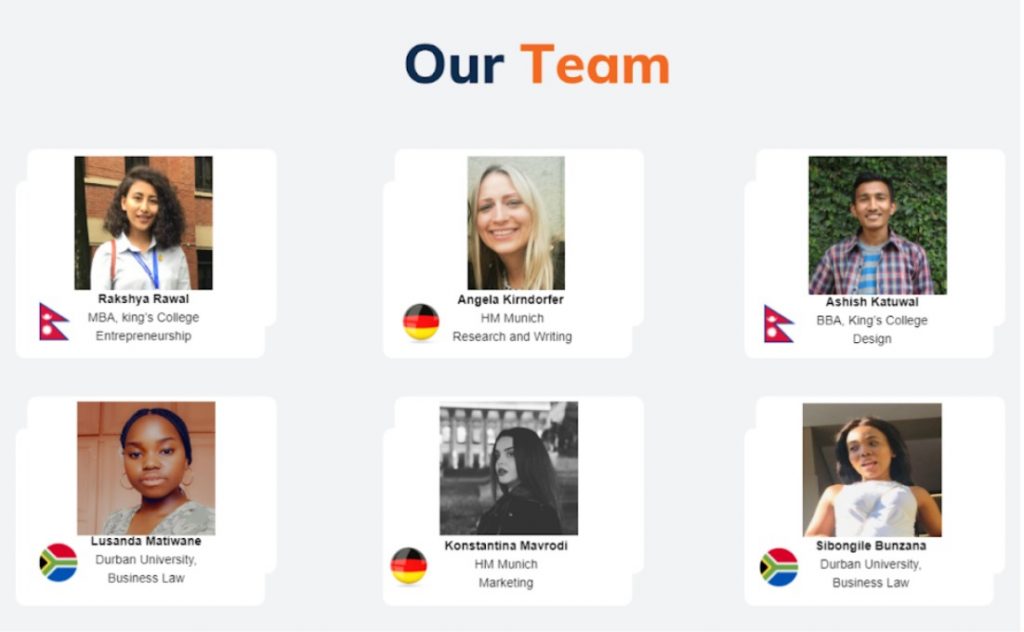
Our team – ‘Team 4: Obeutrition’ – was composed of five dynamic students from three different countries. We decided to select the theme of obesity among teenagers in Germany.

Obesity is a health condition when our body has excessive fat accumulation that increases the risk to our health. Our research showed that obesity can lead to various health problems like heart disease, diabetes, joint problems, and psychosocial problems like bullying and low self-esteem. According to the World Health Organization, an average of 2.8 Million people die each year as a result of being obese or overweight.
We found that 1.9 billion adults & over 340 million adolescents were obese or overweight, out of which 45% are trying to lose weight by excercising and diet changes, but are still unsuccessful. And by the year 2039, the number of children aged 5 to 19 years living with obesity worldwide is expected to increase from 158 million in 2020 to 254 million by the year 2030.
The results of our research showed us the frightening reality of obesity and its impact on people, and it pushed us to collectively work on a solution as a team.

To tackle this problem, our team came up with a solution to create a program called ‘Obeutrition Summercamp’, a summercamp program that helps obese youths develop healthy habbits of eating and exercising by replacing their regular eating routines. Our solution aims to enhance the wholesome lifestyle with the help of behavioral change activities. While working on this solution idea, each member of our diverse team brought in their strengths, perspectives and experiences, and contributed in enriching our learnings.
Lusanda Matiwane from South Africa became the voice of our Project Obesity Camp. Learning about green technology, agriculture and nutrition has motivated Lusanda to develop interests in all of these fields. Working with other students from Nepal and Germany has contributed greatly to Lusanda’s knowledge on learning about different business values and cultures. In addition, learning through technology has inspired Lusanda to invest and look more into it. Furthermore, this whole experience inspired her to be more innovative in her solutions, be an initiator, and excel in working on other people’s ideas.
Rakshya’s motivation for this project came from making people realize that obesity is a serious disease that is hampering the psychological and physical well being of teenagers, while also acknowledging that it is curable. Rakshya’s main encouragement during this project was to ideate and find new ways to alleviate the problem from different dimensions.
Angela has a lot of friends who suffer from obesity, and are ashamed to go out and do sports in public. They were stuck in a vicious circle that is very difficult to get out of. Angela feels that this project could support people like her friends’ physical and mental wellbeing.
Konstantina aims to help obese young people get out of the situation and give their lives more quality again. She believes that eating habits need to be changed in order to counteract health risks. However, she knows that it is very difficult to go on a diet alone without support. That is why she is excited about this project where teenagers who join the camp can come together and openly talk about their problems.
Ashish considers eating to be a serious discipline. He is inspired by healthy diets and food hacks that can help with having balanced diets and eventually a balanced life. So he looks forward to opening the horizon of learning and bringing a change in the perspective of teenagers through the program.
In order to tackle one of the world’s most prominent problems, it required us to collectively think and ideate together in a group, and shape our ideas into an innovative solution. My biggest learning has been to work creatively alongside people from different cultures, language, geography and perspective, and strengthen my entrepreneurial mindset.
“Your goal in life is to find the people, business, project, or art that needs you the most. There is something out there just for you.” NAVAL RAVIKANT
